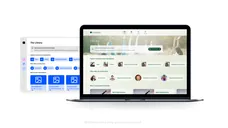
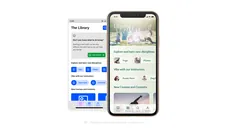
One-line outcome: Turned a pandemic-born idea into a testable wellness MVP by aligning the content model, navigation, and a lean design system—so the team could scale programming without constant rework.
TL;DR
- Problem: A content-led wellness startup had strong creative direction, but the product direction and launch path were undefined while content production ran in parallel.
- What I did: Brought structure through benchmarking, card sorting, and a content model that translated editorial intent into navigable product patterns; used wireframes and prototypes to align the team on an MVP cut.
- Key constraint: Tight timelines, a distributed team, and evolving requirements meant we had to reduce ambiguity early and avoid building bespoke UI for every new content type.
- Outcome: Stakeholders aligned on a realistic MVP scope; engineering could start with fewer open questions; the navigation and design system reduced production friction for new series and programs.
- Timeframe + role: 2020–2021 · UX & Product Design Consultant.
At a glance
- Focus: content model · navigation · MVP cut · repeatable UI patterns
- Methods: benchmarking · card sorting · wireframes · prototyping · lightweight design system
- Core outputs: taxonomy + IA, key flows, MVP scope definition, design patterns for scalable publishing
Context
In 2020–2021, One Firelight set out to rethink home wellness by combining movement, music, and mindful practices. The idea had momentum, but the risk was direction drift: without a clear cut for the first release, content and product could pull in different directions and slow each other down.
The team needed confidence on three fronts: what the MVP actually was, how users would find and complete sessions, and how the platform could grow as the catalog and programming matured.
My Role & Team
I partnered with the founders and team to define the experience and the MVP cut.
- My scope: a scalable content structure (information architecture), a content model, and patterns that reduced day-to-day debate as new content shipped.
- Decision ownership: I translated editorial intent into navigable product structure and helped the team converge on a shippable MVP cut.
- Collaborators: founders, content/programming stakeholders, and a distributed delivery team.
Constraints
- Parallel tracks: Content production and product delivery moved in parallel, so the system had to support publishing speed.
- Evolving requirements: Requirements changed as brand, music, and wellness strands converged.
- Distributed collaboration: Limited time and a distributed team pushed us toward clear, testable decisions over “perfect” visuals.
Approach
I sequenced the work to turn ambiguity into decisions the team could act on:
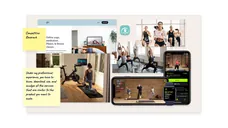
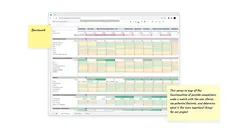
- Benchmark expectations. Benchmarked competitors to map expectations and the basics people expect, then identified where the brand could be different without reinventing everything.
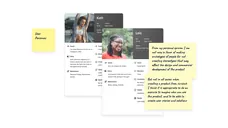
- Pressure-test assumptions. Ran field conversations and an expert review to test assumptions about what people expect from fitness platforms.
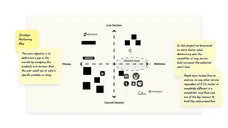
- Shape navigation through card sorting. Used card sorting to shape categories, sessions, and collections so programming felt intuitive.
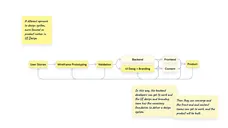
- Validate key flows with wireframes. Designed low-fidelity wireframes to validate navigation, session detail, search, and program progression before investing in polish.
- Build scalable UI patterns. Built a lean design system aligned to editorial needs so new content could ship without bespoke UI.
- Align on MVP via prototypes. Prototyped key flows (including trial and onboarding moments) to align stakeholders on the first release.
Process at a glance
| Phase | What it clarified | Output (decision tool) |
|---|---|---|
| Expectations | What “good” looks like in the category | Benchmark findings + differentiation notes |
| Structure | How people discover programs and progress | Taxonomy + IA shaped by card sorting |
| Flows | Whether the core experience is legible end-to-end | Wireframes/prototypes for navigation, session detail, and progression |
| Scale | How the system stays consistent as content grows | Lean design system + reusable patterns for publishing |
          timeline
Expectations : Clarify what people expect
Structure : Categories and naming that scale
Model : Reusable content types and patterns
Prototype : Test key flows early
First release : Agree what ships now
Key Decisions & Trade-offs
-
Decision: Treat the product as a content platform first (categories, naming, navigation), then layer features.
- Options considered: Build feature-first and retrofit structure later; copy a competitor’s navigation model; start with simple categories designed for growth.
- Criteria used: Discoverability, scalability with catalog depth, speed of content publishing.
- Trade-off accepted: More upfront structure work vs less churn later.
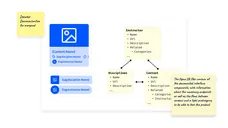
- Resulting implication: A shared content model became the backbone for both design and engineering.
-
Decision: Build a lean design system optimized for repeatable publishing instead of bespoke screens for each program type.
- Options considered: Fully custom UI per content format; a heavy design system; a minimal system with reusable patterns.
- Criteria used: Delivery speed, consistency, collaboration across design and engineering.
- Trade-off accepted: Less visual variation early vs faster iteration and fewer one-off decisions.
- Resulting implication: New series could launch without redesigning core UI patterns.
-
Decision: Define an MVP cut around the simplest path to discovery and completion, deferring community and future “nice-to-have” layers.
- Options considered: Ship a broader feature set; ship a narrow core with a clear expansion path.
- Criteria used: Time-to-launch, ability to test demand, complexity under a distributed team.
- Trade-off accepted: Narrower scope now vs a more confident launch path.
- Resulting implication: The roadmap became explicit about what was intentionally not built yet.
Impact
- Turned an ambitious concept into a shared blueprint the team could build without constant direction resets.
- Established a navigation model that supported series, programs, and catalog depth without rethinking structure each time.
- Reduced friction between editorial planning and product delivery by aligning naming, categories, and UI patterns.
- Provided prototypes that aligned stakeholders on what “MVP” meant in practice, including conversion-critical moments.
What I Learned / What I’d Do Next
When content, naming, and UI patterns share the same language, teams move faster and users understand the offer sooner. Early releases don’t need novelty—they need a clear path to discovery and completion.
Next, I’d validate the categories and naming (plus onboarding) with real catalog growth where edge cases show up, and tighten tracking around trial starts and early-session completion so content planning and product decisions stay connected.
Media & Screenshots of the Project
Media

Screenshots